Visiting the Pech Merle cave with children
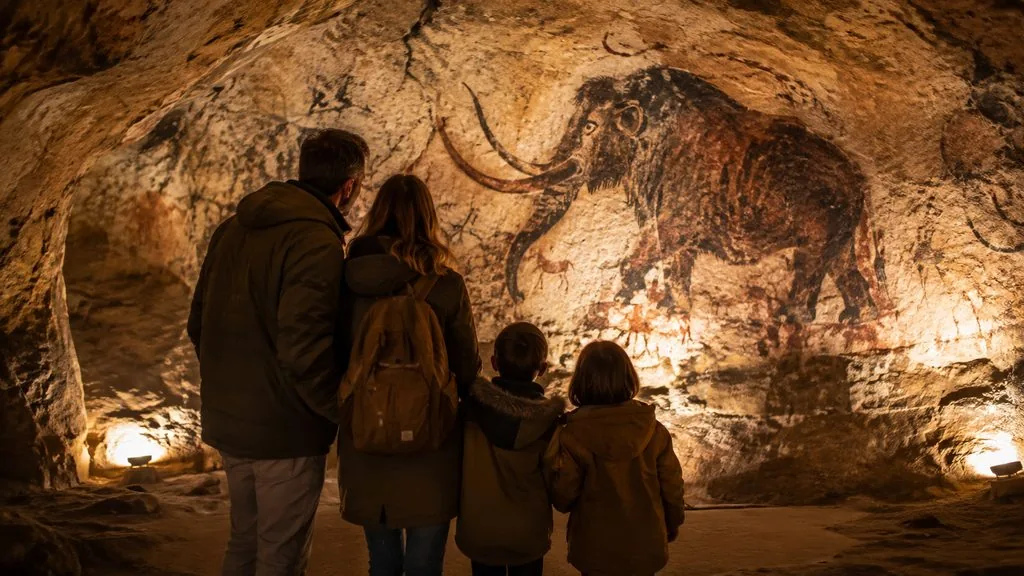
Prehistory on the CM1 Curriculum
My first visit was a Year 4 school trip, and it’s still where Prehistory appears in the curriculum. What the teacher explained in class, the cave shows. The four main periods: the Palaeolithic, the Mesolithic, the Neolithic, and then the Metal Ages. Prehistory begins with the first tools, around three million years ago, and ends with the invention of writing, around 3,300 BC. The paintings in Pech Merle date from the Palaeolithic, between 29,000 and 16,000 years ago, and the Amédée Lemozi museum covers the rest up to the Gauls. A child who knows the school vocabulary will follow everything.
At what age?
The Prehistory Centre advises against the cave for children under three. Between three and six, it depends on the child: an hour in the dark and cold, listening to an adult talk about mammoths, can feel long for some and fascinating for others. From six or seven upwards, it almost always works, especially after the film. Teenagers connect with the footprints of an adolescent their age and the 1922 discovery by three youngsters aged thirteen to sixteen, recounted in history and discovery.
What they remember most
- The spotted horses, at the end, and the game of counting the hands.
- The footprints in the clay, because a foot is tangible.
- The bear wallows in the Combel Gallery, and the engraved bear head.
- The moment when the guide turns off the lights and you realise that the painters worked by the light of fat lamps.
The film, the museum, and the duration
Watch the film beforehand. It’s dated and children may find it slow, but it sets the scene and gives them the names they’ll hear in the cave. The museum is easier to appreciate afterwards, once you’ve seen the walls. In total, allow two and a half hours on site with children; see visit duration. Bring a snack for the exit: there’s a picnic area and a refreshment stand, but nothing to eat down below.
The cold, the stairs, babies
12 °C and humidity. An extra layer for children, closed shoes with good grip, and a hat for little ones. There are stairs and damp passages, so no pushchairs; a baby carrier is fine, but a baby may cry loudly in the gallery and you can’t leave mid-tour. No pets either. The cave is not recommended for those with claustrophobia, which may affect a child who has never been underground before: explain what to expect beforehand. All the details are in how to dress.
Rules to explain beforehand
Do not touch the walls, ever. Do not take photos, even without flash. Stay with the group of 25. Said calmly in the car park, it’s fine; said by the guide in front of everyone, less so.
Which excursion with children
From Toulouse, the private day tour is advertised as family-friendly: pick-up, visit to Cahors, then the cave with a local guide, in French or English, and a pace you can adjust since the group is yours. From Cahors, the small-group tour also works with accompanied children, but the day is long, eight hours including Saint-Cirq and the towpath.
Book the morning slot. Children are more attentive, the cave is quieter, and the afternoon is free for the Célé valley or Saint-Cirq-Lapopie. Slots can be booked on the official ticket office or via the excursion—see booking and tickets.
Frequently asked questions
What is the minimum age to visit Pech Merle?
The cave is not recommended for children under three. From around six or seven, when Prehistory is part of the curriculum, the visit is very suitable. The cold and stairs are described in what to wear.
Can you enter with a pushchair?
No, the route includes stairs and damp passages. A baby carrier is allowed, but you cannot leave the group during the visit. The duration is around one hour; see visit duration.
Is there a child rate?
Yes, the Prehistory Centre offers reduced rates for children and adolescents on the official ticketing site. On an excursion, entry is included. See booking and tickets.