What to do in Cabrerets, around the Pech Merle Cave
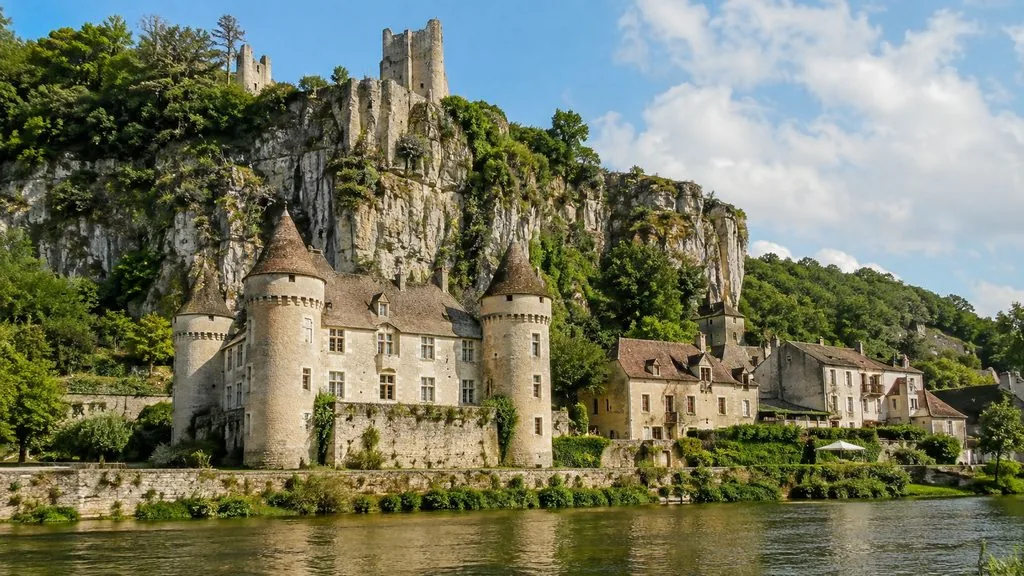
Cabrerets in one hour
I grew up between Cabrerets and Saint-Cirq, and I’ll be honest: the village itself can be visited quickly. What makes it worth stopping is the cliff. The Château de Gontaut-Biron, known locally as the Château de Cabrerets, dates from the 14th–16th centuries, is privately owned, and can be viewed from the road along the Célé. A little further on, clinging to the rock face, are the ruins of the Château du Diable, a stronghold from the Hundred Years’ War, of which only walls remain, seemingly held to the rock by habit. You can see them, but they’re not open to visitors.
The Célé is a narrow, green river that can be explored on foot or by canoe in summer. At Conduché, it joins the Lot, where the roads to Cahors and Saint-Cirq-Lapopie diverge.
Saint-Cirq-Lapopie
A fifteen-minute drive, and you’re beneath the perched village, ranked among France’s most beautiful, which is well-deserved—and comes at a price: in summer afternoons, the main street is a queue. Houses from the 13th–16th centuries, workshops, the church at the top, and the view over the Lot’s loop. André Breton lived here and wrote that he no longer desired to be anywhere else. I understand this in April, less so on August 15th at 3 PM. A private guided tour of the village is available for those who want to learn about the houses’ history, not just the shops.
The towpath at Bouziès
Between Saint-Cirq and Bouziès, a towpath was carved into the cliff above the Lot in the 19th century, allowing men and horses to pull barges. It’s flat, shaded, and one section features a bas-relief carved into the rock. It’s a walk of less than an hour round-trip and the third stop on the excursion from Cahors on the way back.
Cahors
40 km away, Cahors is the city where I live. The Valentré Bridge, a 14th-century structure with three towers, is a UNESCO World Heritage Site as part of the Camino de Santiago. The historic center is best explored on foot, with its market and Malbec wine cellars. It’s the natural starting point for the cave if arriving by train, and the route to Cabrerets always passes through here.
What not to miss in the Lot, further afield
- Rocamadour, with its cliffside sanctuaries, is about an hour away. A small-group guided tour of an hour and a half ensures you don’t miss the highlights.
- The Padirac Chasm, also an hour away, for the underground river.
- Cougnac Caves, in Gourdon, another original decorated cave.
- The Cahors vineyards and the black truffle of Quercy, in winter, with truffle hunting at Château Pech de Jammes.
Have lunch in Cabrerets or picnic at the cave, then head up to Saint-Cirq after 4:00 PM in summer. The light is better, and the coaches have left. Two-day itineraries are in the Lot Valley.
Frequently asked questions
Can you visit the Château de Cabrerets?
No, the Château de Gontaut-Biron is private. It can be seen very well from the road along the Célé, as can the ruins of the Château du Diable in the cliff. The cave, however, must be booked in advance.
How long is the journey between Cabrerets and Saint-Cirq-Lapopie?
Around a fifteen-minute drive. The excursion from Cahors visits the cave in the morning and Saint-Cirq in the afternoon, followed by the towpath.
What not to miss in the Lot in two days?
Pech Merle and Saint-Cirq-Lapopie on the first day, Rocamadour and Padirac on the second, Cahors and its Valentré Bridge in the evening. The details are in the Lot Valley.