Who discovered the Pech Merle cave? 1922, three teenagers and a priest
What was known before 1922
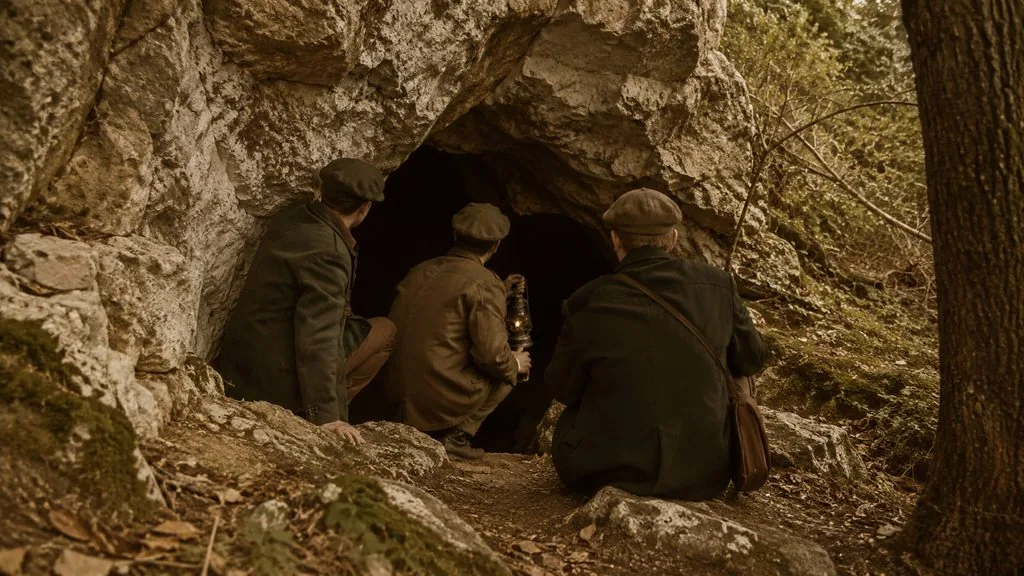
Pech Merle was not unknown. The people of Cabrerets knew there were cavities beneath the hill, and the upper sections were explored. What was missing was the passage to the large decorated galleries, blocked by rockfalls and concretions. An adult couldn’t squeeze through. Children could.
The three discoverers
André David was sixteen, Henri Dutertre fifteen, and Marthe David, André’s sister, thirteen. Abbé Lemozi, who was already excavating prehistoric sites on the causse, had told them what to look for. In 1922, they squeezed through the narrow passage, crawled through the clay, and emerged into chambers where no one had set foot for millennia. They returned to fetch the priest. The introductory film, shown before each tour, recounts this episode with archive footage; it’s dated, but it’s where you grasp the scale of what they discovered.
Abbé Lemozi
Amédée Lemozi was the parish priest of Cabrerets and an amateur prehistorian at a time when the discipline was taking shape. He documented, described, and corresponded with Abbé Breuil, who came to see the walls and called it the “Sistine Chapel of Quercy”. In 1929, Lemozi published The Pech-Merle Cave-Temple, the first monograph. The Prehistory Centre Museum bears his name and displays part of what he collected on Quercy, from Neanderthals to the Gauls.
1923, 1926: developing without damaging
As early as 1923, a staircase was dug near the prehistoric entrance. The 1926 opening to the public involved an artificial shaft to avoid widening the original passage. This choice explains the current route: you descend via a staircase, then follow 1,200 m of wide, high galleries, with fragile areas kept at a distance. Full route details are in what to see in the cave.
1949: the Combel Gallery
André David never really stopped. In 1949, twenty-seven years after the first time, he discovered the Combel gallery, with its bear wallows in the clay, bear and hyena bones, and a set of paintings among the oldest on the site: dots, horses, a feline, and deer. This is now the second stop on the tour.
1952 and beyond: classification, dating, quota
The site was classified as a historic monument in 1952. Then came Michel Lorblanchet’s extensive study, which remains the reference on Pech Merle’s walls: he catalogued around 700 motifs, described the techniques (manganese, iron oxide, spitting for negative handprints) and worked on dating. The spotted horses were radiocarbon-dated to around 29,000 years ago; the paintings as a whole span from 29,000 to 16,000 years ago, from the Gravettian to the Magdalenian period.
The lesson from Lascaux, which closed in 1963 after visitor-related damage, was heeded here: a daily limit of 700 people, groups of 25, and no photography allowed. That’s why booking is mandatory, and it’s also why we can still see the original 1922 paintings rather than a replica.
If the story of the discovery interests you, book a morning slot and allow forty-five minutes for the museum after the cave, when the names of Lemozi and Lorblanchet mean something.
Frequently asked questions
Who discovered the Pech Merle cave?
Three teenagers from Cabrerets in 1922: André David, Henri Dutertre and Marthe David, guided by the advice of Abbé Amédée Lemozi. The Combel gallery was discovered later by André David in 1949. See also the Amédée Lemozi museum.
When did the cave open to the public?
In 1926, through an artificial shaft dug to preserve the original entrance. It has been a listed historic monument since 1952. Today, the visit is guided and must be booked in advance.
How old are the paintings?
Between 29,000 and 16,000 years old for the entire site. The panel of the spotted horses has been radiocarbon-dated to approximately 29,000 years ago. Details by station can be found in what to see in the cave.